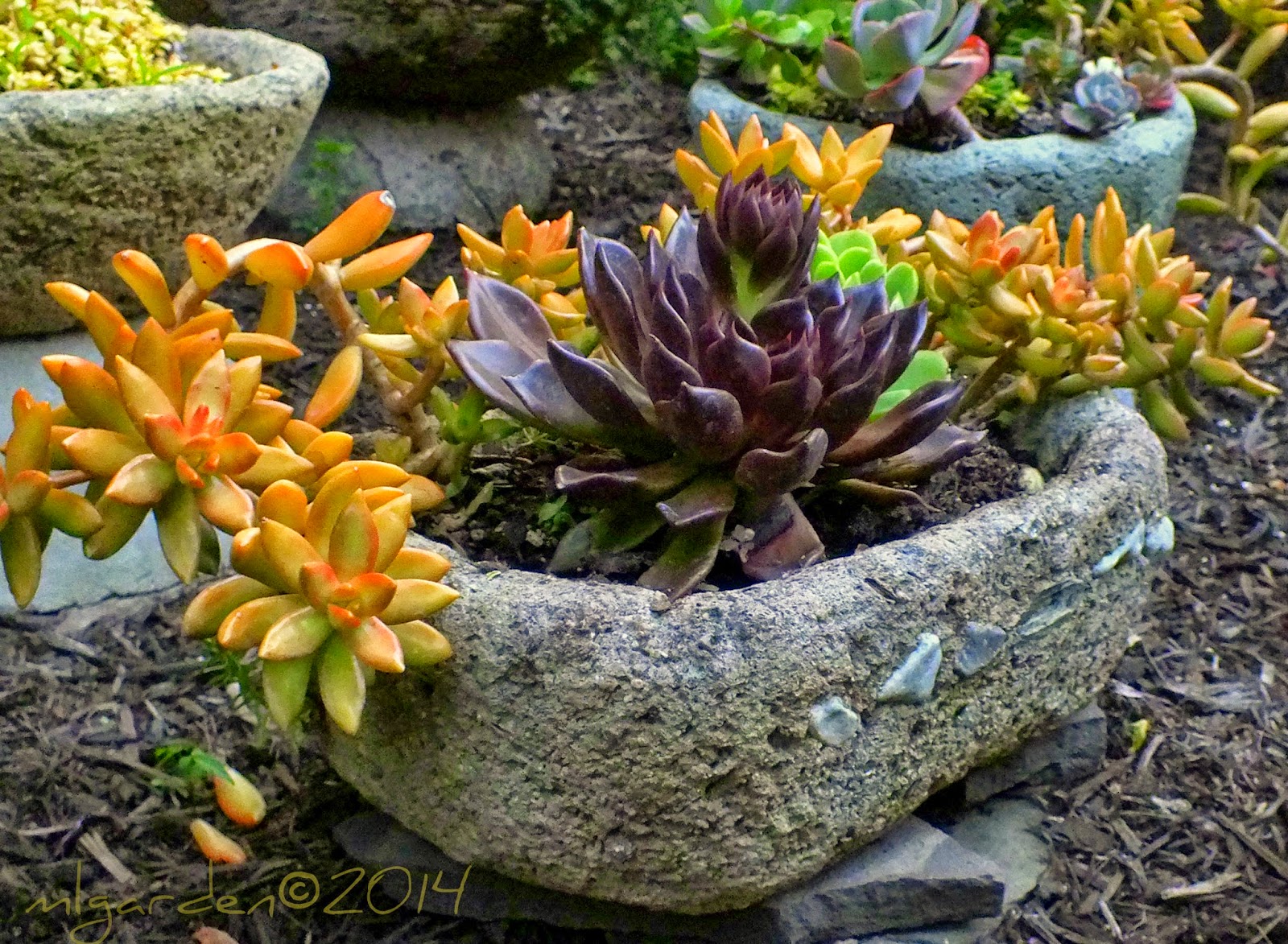
Hypertufa is lightweight pourus material used to make many cool garden projects. Looks like stone but lighter, a workable material allowing you to express your creativity without much artistic talent. To make hypertufa all you need is: portland cement
, peat moss, perlite water and a little creativity!
 |
| Succulents are a great addition to this unique planter |
I saw this planter on Pinterest and decided to make one to display on my garden fence. Below are my instructions for making this Hypertufa Wall Planter.
Things you will need to gather before you
start
- Perlite
- Sphagnum Peat Moss or potting soil
- Portland Cement
- Water
- 2 Kitchen size garbage bags
- Small wire brush
- 2 wire coat hanger
- Dish Pan ( plastic) or something to mix your ingredients in
- Rubber gloves, Particle mask, Safety glasses
- Cardboard, and rectangular plant tray (used to hold annuals at garden center)


Find a place that you can get messy,
preferable outside. For best results it is best if the temperature is above 50 f when making any Hypertufa.
Cover you work space with a cheap vinyl table
cloth. The plastic plant tray will be your mold for the wall planter. Since the tray has open spaces you
will need to cut cardboard to fit on the inside of the tray. Secure with tape. Next cover the plant tray / cardboard with a kitchen size garbage
bag. This step will make it easier to remove the hypertufa ( tufa) the next day. You are ready to mix your ingredients.


I recommend that you always work safely - Put on your gloves, dusk mask and any eye
protection. Wet cement can irritate your skin, and the dust is not healthy for your lungs.
Use a 2 quart container, (from the deli ) to measure the ingredients. The dishpan will be used as a mixing bowl. Place the following dry ingredients into the dish pan: 1 1/2 portland cement, 1 1/2 perlite, 1 1/2 peat moss or potting soil) then MIX together completely.
Use a 2 quart container, (from the deli ) to measure the ingredients. The dishpan will be used as a mixing bowl. Place the following dry ingredients into the dish pan: 1 1/2 portland cement, 1 1/2 perlite, 1 1/2 peat moss or potting soil) then MIX together completely.
Fill 2 qt container with water (you may use more or less, but is a good est.) Then add small quantities
of water to the dry mix , mix with you hands until you get to the consistency of ( uncooked ) meatloaf mix. When you hold a ball of the
mix in your hand it should stick together. If it is too wet, then just add a little
peat/portland cement.
Take you time, mix well. Once the mixing is complete it is time to
place the mix in your mold. Placing the tufa mix in the mold is best done by taking tufa mix and making hamburger patty shape. Place each one in the mold until the bottom is covered. Press all hamburger patties together so that are a solid mass of tufa in the mold! About 1 1/5 "- 2" thick .
While you are putting the mix in the mold you may want to add some reinforcement wire. Cut the coat hangers into two or three approx. 6” pieces. Place in the wet mix to add support. Keep about a cup of the wet tufa mix for later
Keep in mind that you will need to hang this on a wall, and it will be heavy. The easiest way to hang would be to drill one or two hole about 3 in apart near the top of the planter. This can be done after the wall planter is removed from the mold ( next day ) or make a hole now with a pencil ( or anything pointy) while the mix is wet. Another way to hang - use wire coat hanger ( cut to about 8") bend in in half, making a loop. Place the open end into the wet mix, allowing about 1" of the loop end to be exposed.
While you are putting the mix in the mold you may want to add some reinforcement wire. Cut the coat hangers into two or three approx. 6” pieces. Place in the wet mix to add support. Keep about a cup of the wet tufa mix for later
Keep in mind that you will need to hang this on a wall, and it will be heavy. The easiest way to hang would be to drill one or two hole about 3 in apart near the top of the planter. This can be done after the wall planter is removed from the mold ( next day ) or make a hole now with a pencil ( or anything pointy) while the mix is wet. Another way to hang - use wire coat hanger ( cut to about 8") bend in in half, making a loop. Place the open end into the wet mix, allowing about 1" of the loop end to be exposed.
Next take the 6” terracotta pot ( or two smaller pots) and embed into the cement, near the bottom of the wall planter. Add a little mix (cup from above) inside the pot to cover the entire back inside of the pot. You can also place a small decorative stone below the base of the terracotta pot ( into the wet mix) to help support the pot from the bottom.
Almost done - Smooth the top side and the corners of the planter with a small hand trowel. Sorry I forgot to tell you a trowel is needed. If you want to decorate the front of the wall planter consider adding some broken tiles, smooth stones, or whatever top surface. Simply press into the wet tufa. Wipe the tiles clean after you have completed your design.
Finally cover with a plastic garbage bag, twist the end of the bag. Allow the planter to harden for 30 to 48 hrs. Once hardened enough to move, remove from the bag, then carefully turn upside down and remove from the mold. To make it look like stone take the wire brush and rough up the sides. Spray with water and place back in the garbage back for 2-3 weeks.
It will take that long for your wall planter ( the cement) to cure. During this time the planter will become hard and all the ingredients will bond together
Please note during this time Handle with care, the planter is still fragile.
Once cured, rinse again and it is time to plant. - Enjoy
Finally cover with a plastic garbage bag, twist the end of the bag. Allow the planter to harden for 30 to 48 hrs. Once hardened enough to move, remove from the bag, then carefully turn upside down and remove from the mold. To make it look like stone take the wire brush and rough up the sides. Spray with water and place back in the garbage back for 2-3 weeks.
It will take that long for your wall planter ( the cement) to cure. During this time the planter will become hard and all the ingredients will bond together
Please note during this time Handle with care, the planter is still fragile.
Once cured, rinse again and it is time to plant. - Enjoy